Inspirational journeys
Follow the stories of academics and their research expeditions
How Fiber Optic Communication Works — A Practical, End-to-End Explanation

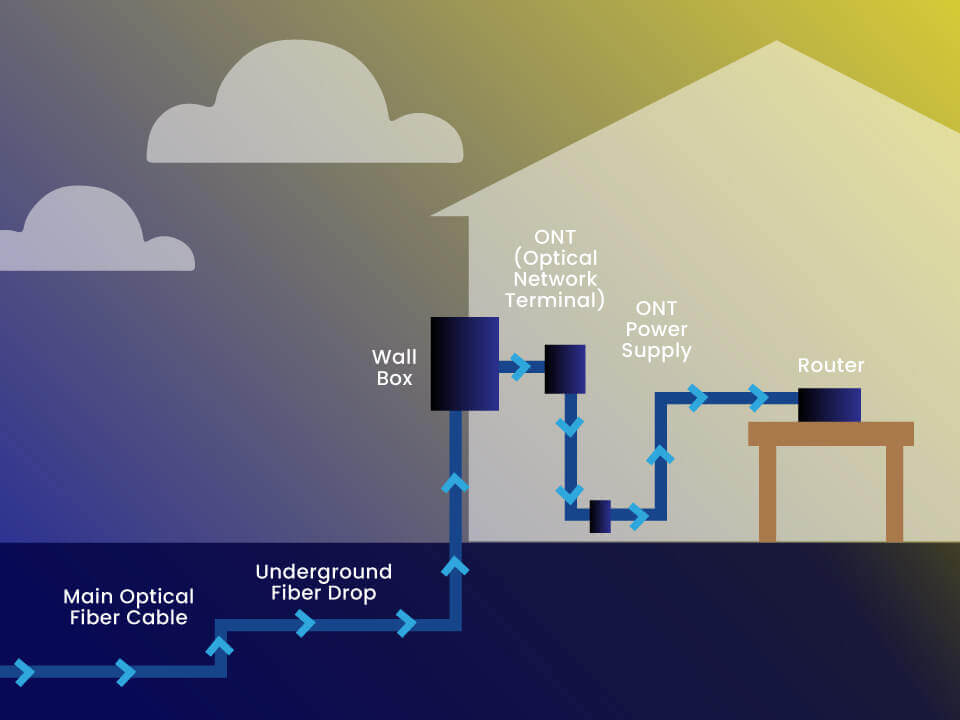
Fiber optic communication is the engine driving the internet and telecom backbone across the UK, the United States, and Canada. Unlike traditional copper cables that rely on electrical signals, fiber networks transmit data as pulses of light that travel through strands made of ultra-pure glass. This technology has redefined global connectivity, enabling everything from video streaming and VoIP calls to 5G transport, cloud systems, cybersecurity infrastructure, and data-driven innovation.
Understanding how fiber optics work is not only fascinating—it is a career-defining skill. My-Communication Academy, the largest telecom and IT training ecosystem in the Middle East and a UK-based online academy, makes this knowledge accessible through ready-made and live courses with real-industry training tracks. This article walks you through exactly how fiber optic communication works, step by step, including examples, installation insights, data flow, and common FAQs.
The Foundations: What Is Fiber Optic Communication?
Optical fiber communication is a method for sending data from one point to another by using light, usually produced by lasers or LEDs. The communication channel is a thin strand of glass or plastic called an optical fiber. These fibers are grouped into cables that can run under streets, across cities, inside buildings, or even through oceans using submarine cable systems.
Key advantages include:
Massive bandwidth and extremely high speeds
Minimal signal degradation over long distances
Resistance to electrical interference
Improved data security
Support for multiple services like internet + voice + video on the same line
Core Components of an Optical Fiber System
A fiber communication link is built around several essential parts:
Core → the inner glass channel that carries light
Cladding → the surrounding layer that reflects light back into the core
Coating/Jacket → protective external layers for durability
Optical Transmitters → lasers or LEDs that create light pulses
Optical Receivers → photodetectors that decode light into data
Transceivers → units that both send and receive light and convert between optical/electrical signals
Connectors → SC, LC, MPO depending on the link type
Multiplexers/Demultiplexers → when using CWDM/DWDM to transmit many signals simultaneously
Testing Tools → power meters, fault locators, splicing machines, and innovative test devices like the most famous fiber trace tester: OTDR
The Physics That Makes Fiber Work: Total Internal Reflection
The magic of fiber optics depends on a physical principle known as Total Internal Reflection (TIR). When light moves from a medium with a higher refractive index (the core) to one with a lower refractive index (the cladding) at a sufficiently steep angle, it cannot escape the glass and reflects forward instead.
This continuous reflection keeps the light trapped and moving, even through twists and long cable paths.
How Do Fiber Optics Transmit Data?
The full transmission process involves:
1. Data Creation
A device (computer, phone, router, or telecom switch) generates digital data in binary format (0/1).
2. Signal Conversion
The data is passed to a transceiver, where it is transformed into light pulses. Each pulse or absence of a pulse represents bits of binary information. This process is called modulation.
3. Light Transmission
The modulated light travels through the fiber’s core, reflecting between the core and cladding thousands of times per second, guided safely to the endpoint.
4. Multiplexing (Optional but industry-critical)
In telecom transport networks, fiber cables don’t just send one signal—they send dozens or even hundreds of channels simultaneously using wavelength multiplexing rules like CWDM and DWDM defined by ITU standards.
5. Reception
At the other side, the optical receiver detects the light and converts it back into an electrical and digital signal using a photodetector.
6. Decoding & Routing
That data is then sent into the network or to end users through routers, ODF/MDF panels, or 5G transport nodes.
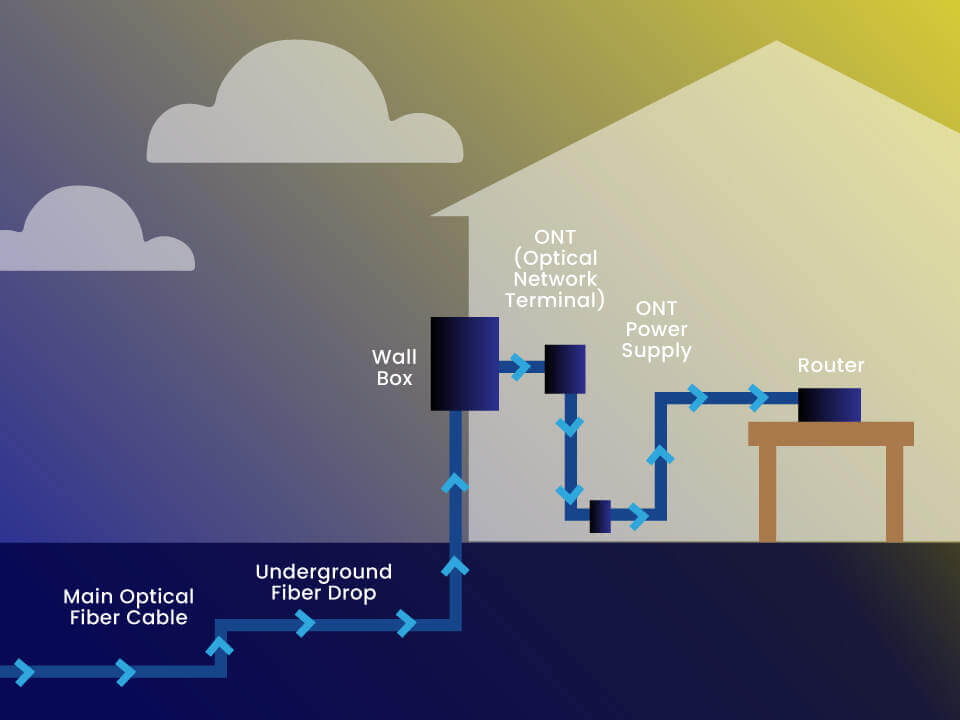
How Fiber Optic Internet Is Installed in Real Life


Although fiber is far smaller and cleaner than copper cables, getting it into your home or campus is a systematic engineering process. Typical steps of installation include:
Planning routes (underground or overhead)
Digging trenches or using ducts
Pulling fiber cables through conduits
Terminating fibers at ODF/MDF endpoints
Splicing fibers using fusion or mechanical methods
Testing signal quality using optical tools
Installing an ONT (Optical Network Terminal) router, which converts the optical signal into Wi-Fi or Ethernet. One of the most popular home endpoints is an ONT Router—similar to industry units like: Huawei EchoLife HG8245H
Delivering service to homes or organizations
Fibre Optic Communication Examples in the Real World
Fiber communication is all around us. Here are practical examples:
Understanding the 3 C’s of Fiber
Fiber engineers evaluate network link performance based on three major quality axes:
1. Capacity
How much data the fiber can carry simultaneously.
2. Clarity
Purity and signal strength inside the glass core—affects attenuation and stability.
3. Connection
Connector quality, splice craftsmanship, and optical budget accuracy.
These 3 C’s form the conceptual foundation for true telecom optical design and deployment.
Important FAQ
How does fiber optic communication work?
Fiber optic communication works by converting digital data into light pulses that travel through a glass core using total internal reflection principles. These pulses are read and decoded at the receiving side by optical transceivers, ensuring high-speed and secure data transport.
How do fiber optics work step by step?
Data is generated in digital format
Converted into light pulses by a transceiver
Light travels through the glass fiber core using reflection
Multiplexed into wavelengths if required
Received and converted back into data
Routed to networks or users
What are optical fiber communication examples?
Examples include submarine cables for international internet, fiber-to-home broadband (FTTH), 5G backhaul, enterprise networking, data-center interconnects, and VoIP phone services over fiber.
How do fiber optics transmit data?
Fibers transmit data by modulating light at high speed. Each pulse or frequency change encodes bits of information. Because fiber uses light instead of electricity, the data arrives faster, cleaner, and more stable over long distances.
How is fiber optic internet installed?
Fiber internet installation involves planning routes, pulling cables through ducts or overhead paths, splicing at endpoints, testing the optical power levels, terminating connections at ODF/MDF panels, then installing an ONT modem/router inside the home or business to convert the optical signal into internet service.
Does fiber optic replace phone lines?
Yes. Fiber optic infrastructure already replaces copper phone lines in many countries by delivering voice services through VoIP over fiber networks, which is faster, clearer, and more reliable than traditional electrical phone lines.
Learn It the Right Way — From Theory to Real Deployment
At My-Communication Academy, learning is not limited to reading diagrams. Whether you are studying telecom, IT, cybersecurity, or data science—you will be trained to:
Understand the physics behind fiber
Design optical budgets end to end
Read OTDR traces like a NOC engineer
Plan fiber backbone, metro, FTTx, and 5G transport
Install and test fiber internet in real life
Learn both recorded and live sessions (fully online)
Start your journey now at the largest telecom and IT online academy delivering real fiber-optic and transmission training:
My Communication Academy
Visit the course portal and begin your practical fiber optics transformation today:
Are you ready to master Optical Fiber Transmission from END-to-END and gain real telecom engineering skills that qualify you for global careers?
Join My-Communication Academy—where fiber, 5G transport, OTN, DWDM, cybersecurity, IT networking, and data science meet in one powerful structured online learning ecosystem.
Start learning now:
Visit the official academy page and enroll online today: my-communication.uk




Leave a comment